Released by BMC in 1956, and seen as the British alternative to the VW Transporter, the Austin-Morris 152/J2 was available in both Austin and Morris versions, with revised front styling for each.
 |
The Austin example can be seen here, in minibus form, with the slatted design of the front grille.
The Austin-Morris Omni model was released in June of 1956. Bodywork was of a unitary construction, with the pressings manufacturing taking place at Nuffield Metal Products, Ward End, Birmingham, and assembly moved to Adderley Park.
|
The Austin example featured a slatted front grille style, with the Morris version featuring an inverted lozenge shape grille. Slightly larger in body shape to the VW, with more bulbous styling to the body sides, many in the UK referred to this model as 'the Hovis van', in reference to the famous British loaf of bread, which did share an uncanny resemblance in shape!
Initially available in four formats, these were the Omnivan, Omnicoach, Omnitruck and chassis cab. As an idea of cost, the Omnivan in 1957 cost £554 in grey primer, with the option of a single paint colour at £28.
The standard petrol engine was the 1498cc B-series, which was replaced with the 1622cc motor from around 1961. There was a 1498 diesel option from 1960, though uptake for this engine option was quite low.
Throughout the remainder of the 1950s, the Austin-Morris Omni vehicle was in direct competition with the Vauxhall-Bedford CA and the Ford Thames within the UK market. All of these light commercial bases were a common sight, performing a variety of tasks, from basic delivery vans, to trade vehicles, airport support, water tenders, gown vans, Luton removal vans, minibus and of course campervans.
By 1960 Rootes had released the Commer 1500FC, offering yet more competition for the 152/J2, and with the introduction of the Ford Transit in 1965, sales of the J2 were hit once again. The Austin-Morris limped on until 1967, when it was replaced by the BMC 250JU.
Surviving examples of the 152/J2 are now something of a rarity, in any form. Some of the best survivors are to be found in Australia, due largely to the climate. Most of the remaining UK examples appear to be campervan/motorhome based, with just a few vans and pickups. The purpose of these blogs is of course motorhomes, so let's take a look at the British examples based on the Austin-Morris 152/J2 between 1956 and 1967.
 |
Seen above is the Austin version of the Car-Camper conversion by Auto Conversions of Birmingham. The front-hinged rising roof was fitted to their early models on the Austin-Morris and Commer, but later discontinued in favour of a solid sided glass fibre roof.
|
 |
Peter Pitt created his first campervan on a VW around 1955. He adapted his 'Open Plan' layout to the Austin-Morris when it was introduced in 56. The early advert seen here is for his Pitt Motir Caravan, complete with rising roof.
|
 |
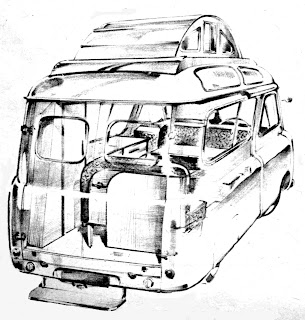
| A cutaway illustration of the Austin-Morris Car-Camper, complete with their trademark tiled floor. |
 |
This is the Wessex Car-O-Van, based on the Austin-Morris, with solid sided rising roof, incorporating side windows.
|
 |
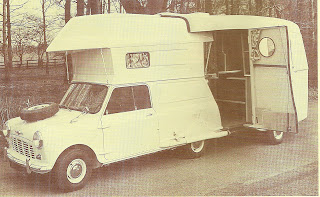
| The Austin-Morris was popular with the home-build enthusiasts. Many basic vans were transformed into DIY campervans. The chassis cab was used by the more adventurous builders for larger motorhomes, such as the one-off example seen here. |
 |
| Built by Locomotors, this is the rather futuristic 'Space Traveller'. Constructed on a chassis cab with single, rear entry door, glass fibreglass roof and curved rear windows. |
 |
| Introduced in 1958 by Bluebird Caravans, this is the Highwayman model. This lovely survivor is from the early 60s, and based on the Morris J2. |
 |
Martin Walter ltd of Folkestone produced the Dormobile range of campervans in the UK. Mostly associated with the Bedford CA in the 50s, but they also offered the Ford Thames and the Austin-Morris J2, seen above in a period advert.
|
 |
| The beautiful wooden interior of an Austin Paralanian motorhome |
 |
An extremely rare version of the Paralanian based on the Morris J2
|
 |
| The 'Cotswold Comet'. Possibly the first production campervan in the UK to feature a fibreglass hightop roof. Based on the Austin 152, this was the first in a series of models produced by Bedford Coachworks for the Cotswold brand. |
 |
The Austin Paralanian motorhome, with its stretched canvas roof, seen here with an Austin A30 in matching livery.
|
 |
The 'Series C' Cotswold motorhome was initially available on the Austin 152, and later on the 250 JU
BMC. |
 |
| Sales brochure cover for the Cotswold Series A campervan, with hightop roof. |
 |
| This is a model which very little is known about, as it does not appear in any buyers guides of the time. This is the Morris 'Superlite', with rear raised roof section in fiberglass. Produced in Bowness on Windermere, possibly by a boat specialist? |
 |
This is a rare Paralanian, notably for the side door entrance, which was requested by the owner, Jacintha Buddicum, a childhood sweetheart of author Eric Blair (George Orwell).
|
 |
The 'Madisons Special' on the Morris J2. Possibly a one-off bespoke conversion.
|
 |
| The Martin Walter (Dormobile) Austin_Morris. Nice period publicity shot, taken near the Dormobile factory in Folkestone. |
 |
| This photo appeared in the sales brochure for the Dormobile Austin-Morris |
 |
| Artist cutaway illustration for the Bluebird Highwayman. The Highwayman was available on the Austin_Morris between 1958-1964. Between 1964-1975 the Highwayman was only available on the Rootes/Chrysler Commer. |
 |
| Advert for the early 1960s range of 'Cotswold' motorhomes available on the Austin-Morris 152/J2 |
 |
| J H Jennings of Sandbach introduced their Jennings Roadranger in 1964. Available on the Austin-Morris 152/J2, Commer, Leyland 20, and the Ford Transit from 1965. The Bedford CF was added as an option in 1969. |


Comments
Post a Comment